
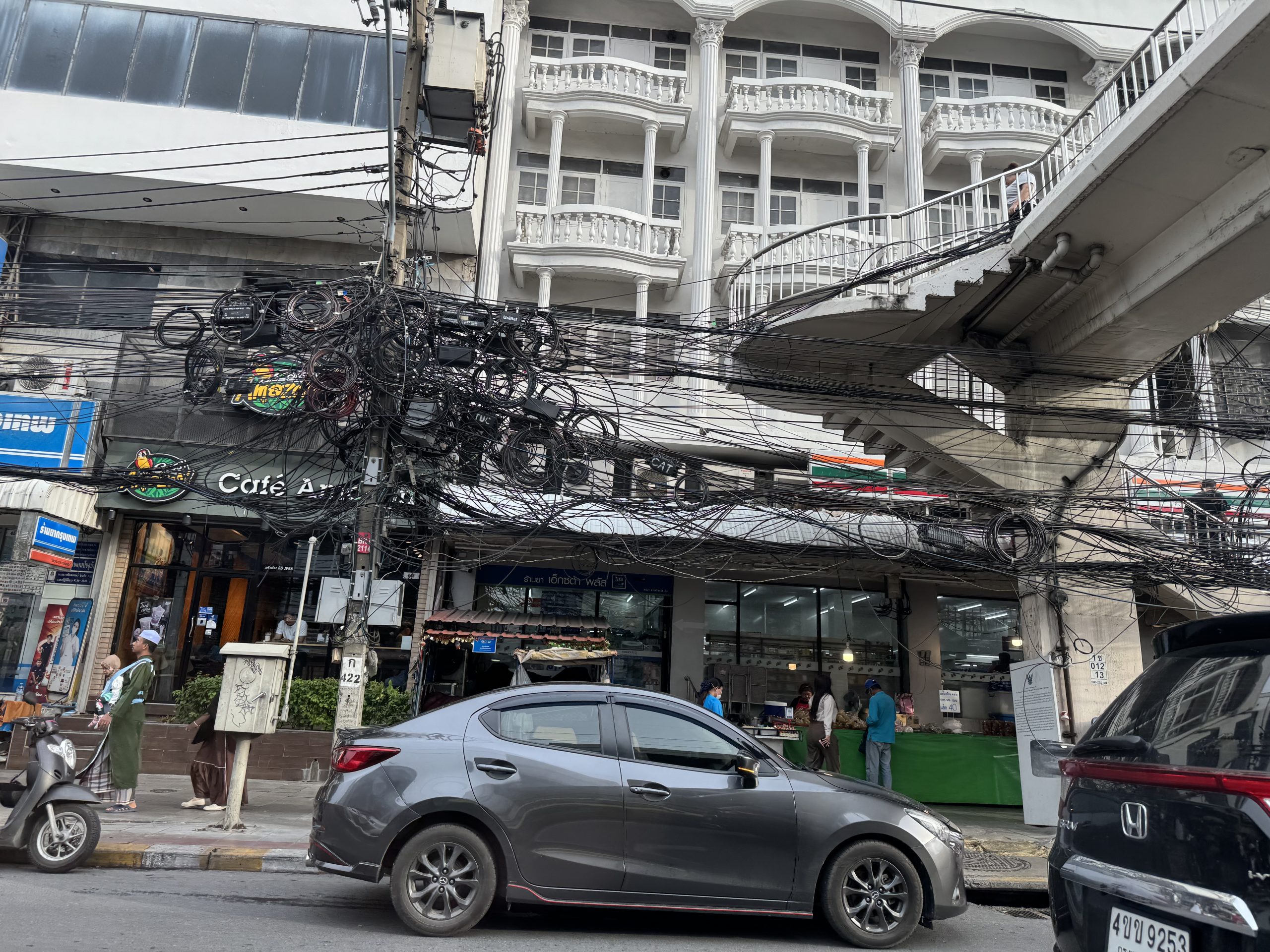
Bangkok is an amazing city: active, vibrant, hot, and crowded! During a recent visit, I enjoyed sampling the food, touring the temples, taking jitney rides, shopping, and just plain walking around. One of the things I was surprised to see, though, is that Bangkok is not a “tap-to-pay” city, and that stands in stark contrast to what one sees in modern cities throughout Asia and Europe. The vast majority of Bangkok vendors still seem to prefer doing business in hard currency – the good old Thai baht. I’m wondering if the scene above might be at least part of the reason for this.
Much of the on-the street communication infrastructure looked like what is pictured above. Every utility pole seemed to be surrounded by an incredibly tangled mess of wires and communications equipment like splitters, couplers, and amplifiers. This is what my old U-M electronics professor Fred Barton used to call a “rat’s nest,” and it’s hard to see how such a system could be efficiently operated and maintained.
Does the current state of Thai communications infrastructure represent a problem, or an opportunity? Has the need for most low-voltage wiring been replaced by terrestrial wireless or satellite communications? What about cable tv and high-speed internet connections? If you know why the current apparent mess exists, what’s being done about it, or what opportunities may result, feel free to comment below.